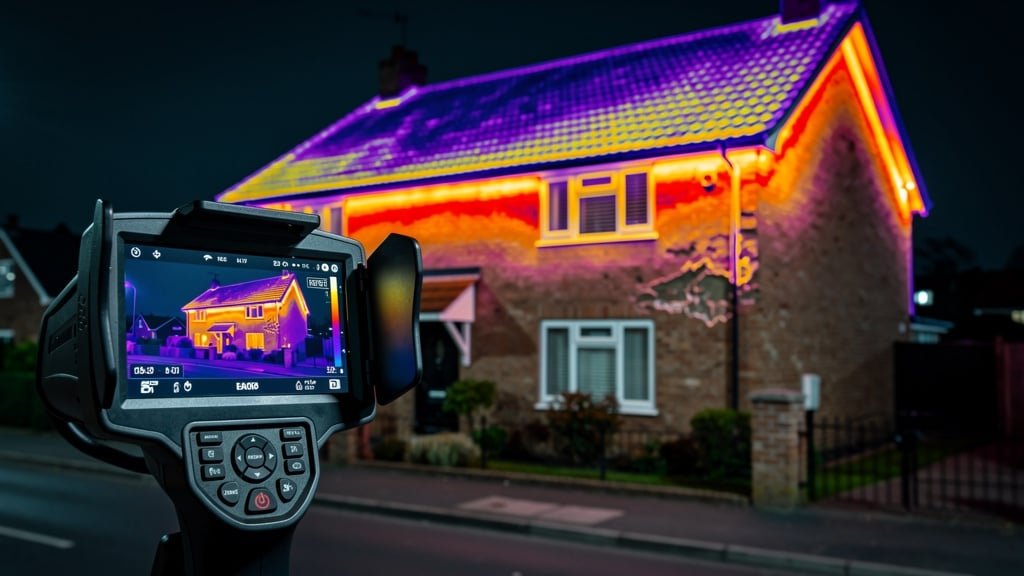
Thermal imaging technology has revolutionized roof surveying by revealing problems completely invisible to the human eye—moisture trapped within roof structures, insulation defects, air leaks, and water ingress that hasn't yet caused visible interior damage. My Roof Surveyor UK uses advanced thermal imaging cameras to detect these hidden issues, enabling targeted repairs before minor problems escalate into expensive structural damage.
This comprehensive guide explains how thermal imaging works for roof surveys, what problems it detects, when you should consider thermal surveys, and how this technology protects your property investment by identifying issues in their earliest stages.
Understanding Thermal Imaging Technology
Thermal imaging cameras—also called infrared cameras—don't capture visible light like standard cameras. Instead, they detect infrared radiation (heat) emitted by all objects and convert it into visual images showing temperature differences.
How Thermal Imaging Reveals Roof Problems:
Different materials and conditions emit different amounts of infrared radiation:
- Dry insulation: Maintains consistent temperature patterns
- Wet insulation: Retains heat differently, appearing as distinct temperature anomalies
- Air leaks: Show as temperature variations where warm interior air escapes
- Missing insulation: Creates hot or cold spots depending on weather conditions
- Thermal bridging: Structural elements conducting heat appear as linear temperature patterns
Professional thermal cameras detect temperature differences as small as 0.1°C, revealing subtle problems that indicate moisture ingress, insulation defects, or air infiltration long before they cause visible interior damage.
Key Problems Thermal Imaging Detects
Thermal imaging roof surveys identify multiple problem types that visual inspection cannot reveal.
1. Hidden Moisture and Water Ingress
The primary application for thermal imaging in roof surveys is moisture detection. Water trapped within roof structures appears as distinct thermal patterns because:
- Wet materials have different thermal properties than dry materials
- Water absorbs and retains heat differently than insulation or timber
- Evaporation creates cooling effects visible on thermal imagery
- Saturated insulation loses thermal resistance, creating temperature anomalies
Real-world case study: A Birmingham office building showed no visible interior water damage, but the facilities manager noticed slightly higher heating costs. Our thermal survey revealed moisture affecting approximately 35% of the flat roof insulation. The problem stemmed from failed seams in EPDM membrane allowing gradual water penetration during heavy rain. Because we detected this early—before interior damage occurred—targeted repairs cost £4,200 rather than the £18,000+ required if the problem had progressed to interior damage and structural rot.
2. Insulation Defects and Missing Coverage
Thermal imaging reveals insulation problems instantly:
- Missing insulation: Gaps where insulation was never installed or has been removed
- Compressed insulation: Areas where insulation has been compressed, reducing effectiveness
- Disturbed insulation: Sections moved by rodents, contractors, or wind infiltration
- Inadequate depth: Areas with insufficient insulation thickness
- Thermal bridging: Heat escaping through uninsulated structural members
A Leeds semi-detached property had heating bills 40% higher than the identical attached neighbor. Thermal survey revealed that half the loft insulation had been pushed aside during previous electrical work and never replaced—creating massive heat loss invisible from inside the loft due to boarding. Replacing the insulation cost £850 and reduced heating bills by £600 annually.
3. Air Leakage and Infiltration
Thermal imaging identifies air movement through roof structures:
- Gaps around roof penetrations (chimneys, soil pipes, roof lights)
- Eaves ventilation that's excessive or improperly installed
- Ridge vent problems allowing air infiltration
- Gaps in roof covering creating drafts
- Wall-to-roof junctions with inadequate sealing
These air leaks waste energy and can draw moisture into roof spaces, creating condensation problems that damage timber and insulation.
4. Flat Roof Membrane Problems
For flat roofs, thermal imaging is particularly valuable:
- Moisture mapping: Precisely identifying which areas have saturated insulation
- Leak source identification: Tracing water ingress to specific membrane defects
- Repair verification: Confirming previous repairs actually solved moisture problems
- Targeted replacement planning: Determining if entire roof needs replacement or just affected sections
A Manchester warehouse with a large flat roof had experienced leaks. Rather than replacing the entire 800m² roof at £72,000, our thermal survey pinpointed three specific areas totaling 120m² with moisture problems. Targeted replacement of just these sections cost £10,800—saving the business over £60,000 while solving the problem completely.
Optimal Conditions for Thermal Roof Surveys
Thermal imaging effectiveness depends significantly on survey timing and weather conditions.
Ideal Survey Timing:
For moisture detection (most common):
- After rainfall: Wait 24-48 hours after significant rain for moisture to penetrate
- Evening surveys: Conduct after sunset when direct solar heating has dissipated
- Temperature differential: Requires at least 10°C difference between interior and exterior
- Stable weather: Avoid windy conditions that affect surface temperatures
For insulation assessment:
- Cold weather: Winter months when heating creates maximum interior-exterior temperature difference
- Evening or night: When interior spaces are warmest relative to exterior
- Heating on: Building should be heated to create thermal gradient
Why Timing Matters:
Direct sunlight heats roof surfaces unevenly, creating temperature patterns that mask the subtle differences thermal surveys need to detect. Evening or early morning surveys, after solar heating has equalized, provide clearest moisture detection.
For flat roofs, the "thermal crossover" period—approximately one hour after sunset—is ideal. At this point, wet insulation retains heat while dry areas have cooled, creating maximum contrast.
The Thermal Survey Process
Professional thermal imaging roof surveys follow systematic procedures ensuring comprehensive assessment.
Pre-Survey Preparation:
- Review property construction documents and previous survey reports
- Verify weather conditions meet survey requirements
- Plan survey route covering all roof areas systematically
- Calibrate thermal camera for current atmospheric conditions
Survey Execution:
External thermal imaging: Surveyor systematically scans entire roof surface with thermal camera, capturing:
- Wide-area thermal images showing overall roof condition
- Close-up thermal images of any anomalies detected
- Standard photographs of same areas for comparison
- Temperature readings at specific points of interest
Internal thermal imaging: From loft spaces or interior rooms, surveyors scan:
- Underside of roof decking for moisture patterns
- Insulation distribution and effectiveness
- Ceiling areas below roof for water ingress evidence
- Air leakage around penetrations and edges
Analysis and Reporting:
Professional surveyors analyze thermal imagery to:
- Identify temperature anomalies indicating problems
- Differentiate between moisture, insulation defects, and thermal bridging
- Quantify extent of affected areas
- Recommend specific remedial actions
- Provide cost estimates for necessary repairs
Reports include both thermal images and standard photographs showing exact problem locations, making it easy for property owners and contractors to understand findings and target repairs precisely.
Interpreting Thermal Images
Understanding what thermal images show helps property owners appreciate survey findings.
Common Thermal Image Color Schemes:
Most thermal cameras use color palettes where:
- Red/white/yellow: Represent warmer areas
- Blue/purple/black: Represent cooler areas
- Green/orange: Represent intermediate temperatures
Typical Problem Patterns:
Moisture in flat roofs: Appears as warmer areas (red/yellow) after sunset because wet insulation retains heat longer than dry areas.
Missing insulation: Shows as cooler areas (blue) in winter when viewing from inside, or warmer areas when viewing from outside, indicating heat escaping through gaps.
Air leaks: Appear as streaks or plumes of different temperature showing air movement paths.
Thermal bridging: Linear patterns following structural members (rafters, joists) showing heat conducting through uninsulated elements.
Combining Thermal Imaging with Other Survey Methods
Thermal imaging delivers maximum value when combined with traditional survey techniques.
Complementary Survey Approaches:
Thermal + Visual inspection: Thermal imaging identifies problem areas; visual inspection confirms physical condition and determines cause.
Thermal + Drone surveys: Drones equipped with thermal cameras survey large commercial roofs quickly, identifying moisture-affected zones requiring detailed investigation.
Thermal + Moisture meters: Thermal imaging indicates likely moisture; invasive moisture meters confirm and quantify moisture content in specific materials.
Thermal + Core sampling: Thermal surveys identify affected areas; physical core samples verify construction details and moisture extent.
My Roof Surveyor UK typically recommends comprehensive surveys combining multiple technologies for the most complete assessment, particularly for commercial properties or complex residential cases.
Cost-Benefit Analysis of Thermal Surveys
Thermal imaging surveys cost more than basic visual surveys but deliver significant value.
Typical Costs:
- Residential thermal survey: £600-£900
- Commercial thermal survey: £800-£2,000+ depending on roof area
- Drone thermal survey (large properties): £1,200-£2,500
Value Delivered:
Targeted repairs: Precisely identifying problem areas prevents unnecessary wholesale roof replacement. A £800 thermal survey that identifies 20% of a roof needs repair versus 100% replacement saves £15,000-£30,000.
Early problem detection: Finding moisture before interior damage occurs saves structural repair costs. Detecting a £500 leak early prevents £10,000+ rot remediation.
Energy savings: Identifying insulation defects and air leaks enables targeted improvements that reduce heating costs by 20-40% annually—payback period typically under 3 years.
Insurance evidence: Thermal surveys provide indisputable documentation of hidden damage for insurance claims, often making the difference between claim acceptance and rejection.
When to Request Thermal Imaging Surveys
Certain situations particularly benefit from thermal survey technology:
Recommended Scenarios:
- Unexplained high energy bills: Heating costs increased without obvious cause
- Flat roof assessments: Any flat roof survey should include thermal imaging
- Pre-purchase surveys: Detecting hidden problems before property purchase
- Post-storm assessment: Identifying water ingress not yet causing visible damage
- After roof repairs: Verifying repairs solved moisture problems
- Persistent minor leaks: When leak source cannot be identified visually
- Commercial property management: Proactive maintenance planning for large roof areas
- Insurance claim support: Documenting hidden damage for claims
Key Takeaways
- Thermal imaging reveals moisture, insulation defects, and air leaks invisible to visual inspection
- Technology detects problems before they cause visible interior damage
- Evening surveys after rainfall provide optimal moisture detection conditions
- Targeted repairs based on thermal surveys save thousands versus wholesale replacement
- Flat roofs particularly benefit from thermal imaging assessment
- Combined thermal and visual surveys deliver most comprehensive assessment
- Investment in thermal surveys pays for itself through targeted repairs and energy savings
Frequently Asked Questions
Thermal imaging is highly effective at detecting moisture within roof structures, but it doesn't directly "see" leaks. It detects the moisture resulting from leaks by identifying saturated insulation, damp timber, or wet roof deck. Small, intermittent leaks that haven't yet saturated materials might not show clear thermal signatures. However, for most scenarios—particularly flat roofs—thermal imaging successfully identifies moisture problems that visual inspection would miss entirely.
When conducted under proper conditions by trained professionals, thermal imaging is extremely accurate for identifying moisture and insulation problems. Modern thermal cameras detect temperature differences as small as 0.1°C. However, accuracy depends heavily on survey timing, weather conditions, and surveyor expertise in interpreting imagery. Direct sunlight, rain during surveys, or insufficient temperature differentials can compromise results, which is why professional surveyors carefully schedule surveys for optimal conditions.
For flat roofs, pre-purchase surveys, or when hidden problems are suspected, thermal imaging delivers exceptional value. The additional £300-400 cost typically saves thousands by enabling targeted repairs rather than wholesale replacement, detecting problems before structural damage occurs, or revealing defects that affect purchase negotiations. For straightforward pitched roof inspections without moisture concerns, standard visual surveys may suffice. Discuss your specific situation with surveyors to determine if thermal imaging is worthwhile for your circumstances.
Consumer-grade thermal cameras are available, but professional roof surveys require specialized expertise beyond equipment. Professional surveyors understand optimal survey timing, can differentiate between various thermal patterns, know what anomalies indicate actual problems versus normal variations, and provide defensible reports for insurance or legal purposes. Additionally, professional equipment has superior resolution and sensitivity. While consumer cameras can be useful for basic DIY assessment, professional surveys are recommended for making repair decisions or supporting insurance claims.
For moisture detection in flat roofs, any season works if proper conditions exist (recent rainfall, evening timing, no direct sunlight). For insulation assessment, winter months are ideal when heating creates maximum temperature differential between interior and exterior. Spring and autumn provide good middle-ground conditions. The key factor isn't the season per se, but rather having appropriate temperature differential and post-rain timing for moisture surveys. Professional surveyors schedule surveys based on your specific assessment needs and current weather conditions.
Schedule Your Thermal Imaging Survey
My Roof Surveyor UK employs advanced thermal imaging technology combined with professional surveying expertise to detect hidden roof problems before they escalate into expensive repairs. Our thermal surveys identify moisture, insulation defects, and air leakage that visual inspection cannot reveal.
Whether you're assessing a flat roof, investigating unexplained high energy costs, or conducting pre-purchase due diligence, thermal imaging delivers invaluable insights protecting your property investment.